
An annual update of industry investment and revenue trends offers country-level input to the wider debate on the financial health of European telecoms
Investment has declined as major fibre rollout programmes have passed their peak
On 22 September 2026, the Danish Agency for Digital Government (known locally as Digitaliseringsstyrelsen) published updated figures for the economic activity of the country’s telecoms sector. The statistics indicate that the industry continues to make a considerable investment in digital infrastructure, with a total investment of DKK8.6bn (£989.3m) in 2025. This includes investment in the rollout of broadband, switching and transmission equipment, and cable equipment. As a result, the agency states that there is now “very good” broadband coverage throughout Denmark; more than 99% of all homes and businesses have access to “fast internet” services, while 92.3% have access to fibre. However, total capex decreased by approximately DKK650m (£75m) compared to 2024, in particular due to a reduction in new fixed-line (mainly fibre) deployments, which Digitaliseringsstyrelsen considers is a reflection of several years of significant network investment.
Operators in Denmark are making more money from mobile users
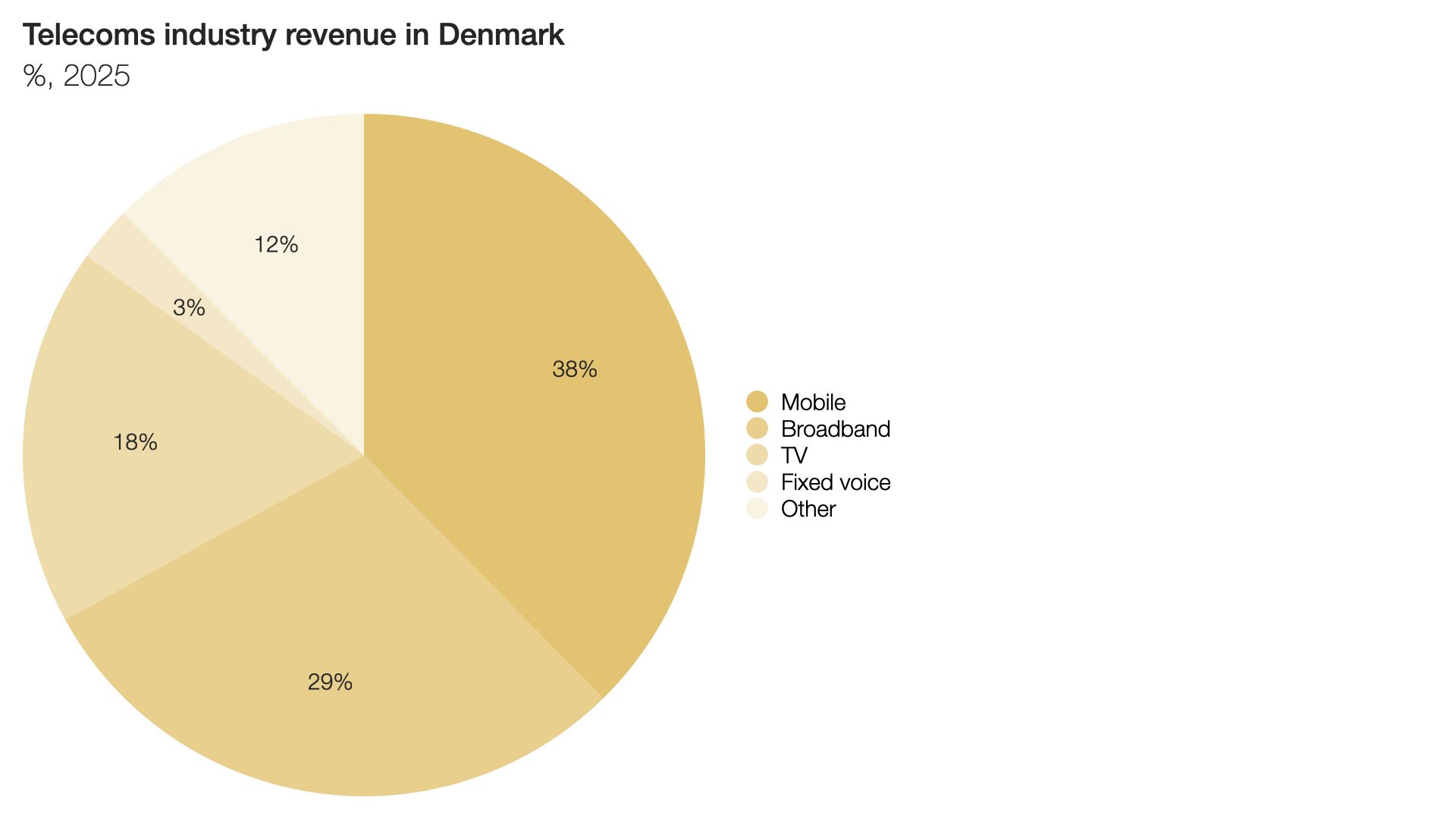
Digitaliseringsstyrelsen states that mobile operators in Denmark have invested billions to deliver nationwide 5G coverage. Capex consequently declined in 2025, following the same investment cycle as with previous network upgrades to 3G and 4G. According to the agency, consumers have embraced 5G, with the number of subscriptions rising by more than 200,000 between 2024 and 2025. Mobile is the main driver of revenue growth in the sector, accounting for DKK17.5bn (£2.0bn) – or 38% – of the industry's total revenue of DKK46.3bn (£5.3bn). In contrast, revenue from landline telephony continues to decline, now amounting to just DKK1.2bn (£138.0m). Revenue from broadband and TV services account for almost 30% and 18% of overall revenue, respectively.
Profit margins have slimmed, although the industry may have become more efficient
Although revenue is growing, the agency reports that operators’ profit margins are declining. In 2025, the telecoms industry had an average profit margin of 5.0%, down from 6.1% in 2024 – and from 7.2% in 2021. These country-level figures are notable in light of continued debate over the financial health of Europe’s telecoms sector, with relatively optimistic pictures painted by both DG COMP and BEREC. Despite the year-on-year (YoY) reduction in margins, Digitaliseringsstyrelsen considers that operators may be becoming more efficient, with turnover per employee increasing in both 2024 and 2025. Each employee in the telecoms industry in Denmark now represents a turnover of almost DKK4m (£460,000). Part of the reason for this is that employment in the sector decreased in 2025, falling to around 11,700 full-time employees. Over the course of the past 10 years, the number of employees in the Danish telecoms industry has decreased by 13.1%. This situation reflects an ongoing trend in Europe, with various operators having lowered headcount over time, including YoY, or planning to effect workforce reductions over the coming years.
